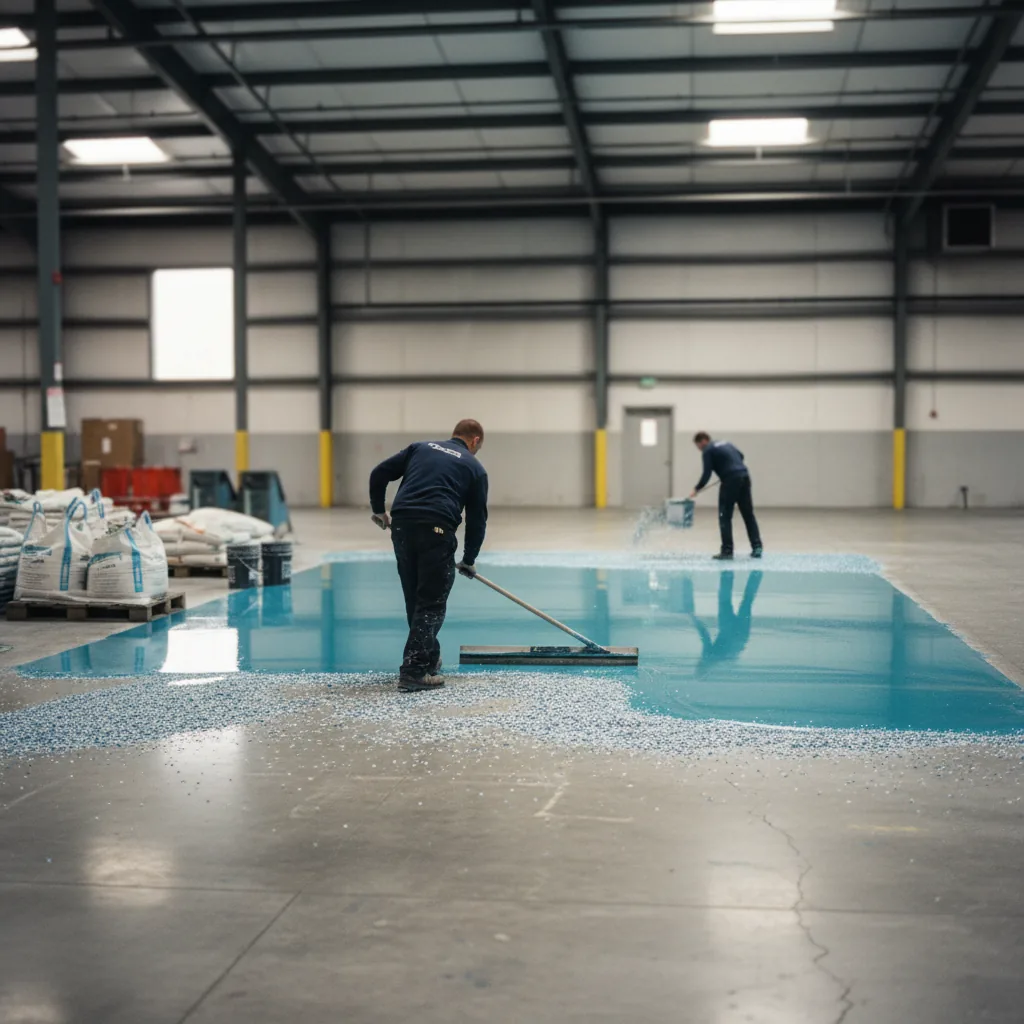
A shop, warehouse, or showroom floor gets picked for what rolls over it and what spills on it.
Quick answer: Commercial floors are quoted per project after a walk-through. The per-square-foot rate usually drops as the floor gets larger. What moves the price most is slab condition, the thickness of the system your traffic needs, and whether the work has to happen in stages around your hours.
Hard wheels put a lot of weight on a small spot. When a loaded forklift turns in place, it grinds at the surface. A thin coating wears through in the lanes. Traffic floors get a thicker, higher-build system. Joints matter here too. Hard wheels hitting an open joint chip the concrete edges on both sides. Filling joints with a semi-rigid joint filler before coating supports those edges. Chipped joints and spalls are repaired first, as the concrete repair page explains.
Auto and fleet shops see oil, brake fluid, antifreeze, and cleaning solvents. Other businesses see acids, sugars, or cleaning chemicals. Each coating has a chemical resistance chart that lists what it handles and for how long. Make a list of everything that can hit your floor, and how long it might sit before someone cleans it up. That list decides the topcoat.
Floors that get hosed down or stay wet need texture, and a lot more than a garage floor. Grit or aggregate goes into the topcoat so people keep their footing. Floors that see hot water washdown or big temperature swings often call for a urethane cement system, which handles that stress better than standard epoxy. The post on slippery epoxy floors covers how texture is added.
Showrooms, retail floors, and lobbies are picked for looks and easy cleaning. Flake and metallic finishes work well, with a topcoat that holds its color where sunlight comes through the windows. See the decorative flake and metallic page for those looks.
| Space | Main stress | Common direction | Texture |
|---|---|---|---|
| Auto repair or fleet bay | Fluids, hot tires, dropped tools | High-build epoxy with a chemical-resistant topcoat | Light grit |
| Warehouse aisles | Forklift wheels, turning | Thicker epoxy build, filled joints | Light, more on ramps |
| Wet or washdown room | Standing water, hot water | Urethane cement or heavy-texture system | Medium to heavy |
| Showroom or retail | Foot traffic, appearance | Flake or metallic with a UV-stable topcoat | Light grit |
These are starting points only. The right system depends on your slab and on what each product is rated for. For a broader view, read about commercial epoxy flooring, or see how a coating compares with polished concrete.
For most businesses, the hardest part is closing the floor. Large floors can be done in sections so part of the space keeps working. Fast-curing polyaspartic topcoats shorten how long each section stays closed. Cure times before foot traffic, carts, and forklifts are all different, and the product sheet sets each one. Share your hours, the areas that cannot close, and when trucks come and go. The schedule gets built from that.
Commercial slabs often carry years of oil, sealer, curing compounds, or an old coating. All of it has to come off. Large walk-behind grinders or shot blasters open the surface, with HEPA-filtered dust vacuums running the whole time, since concrete dust contains silica. Oil-soaked areas may need extra cleaning or a primer made for that. Moisture gets tested too, since many commercial slabs sit on grade with no vapor barrier. The trade-offs between surface prep methods are in grinding vs acid etching.
Coating odor can travel through a building's air system into offices and storefronts. Plan with your facilities person to shut off or seal returns near the work area and to exhaust air outside. Solvent-based products are flammable while they cure. Propane forklifts, gas heaters, welding, grinding sparks, and pilot lights all have to stay well away. Keep staff out of the marked area until the product sheet says it is ready.
Call or text the type of business, rough square footage, and a few photos of the floor. The walk-through and estimate are free. We coat floors in Madison, Sun Prairie, Fitchburg, Middleton, Verona and Waunakee.
Many floors can be done in stages. The floor gets split into sections, and each one is closed off, ground, coated, and cured before the next one starts. Fast-curing topcoats shorten the time each section is closed. Odor and dust still have to be kept away from staff and customers, so the plan covers air flow too.
They solve different problems. Polished concrete is ground and densified, with no layer on top to peel, and it suits dry floors with heavy traffic. A coating seals the slab against spills and adds color, texture, and safety markings. Floors with chemicals or oil usually do better with a coating.
The coating is carried down into the edge of the drain or stopped at a clean edge so water runs off the floor and into it. The slope to the drain stays the same. Texture near drains matters, since that is where the floor stays wet longest.
Only if the old coating is still bonded tight and the new product is compatible with it. Peeling, chipped, or chemically damaged coatings get ground off. A small test patch is a cheap way to check bond before coating a large floor.
They can be laid into the coating and sealed under the topcoat, so they wear with the floor instead of scuffing off like tape.