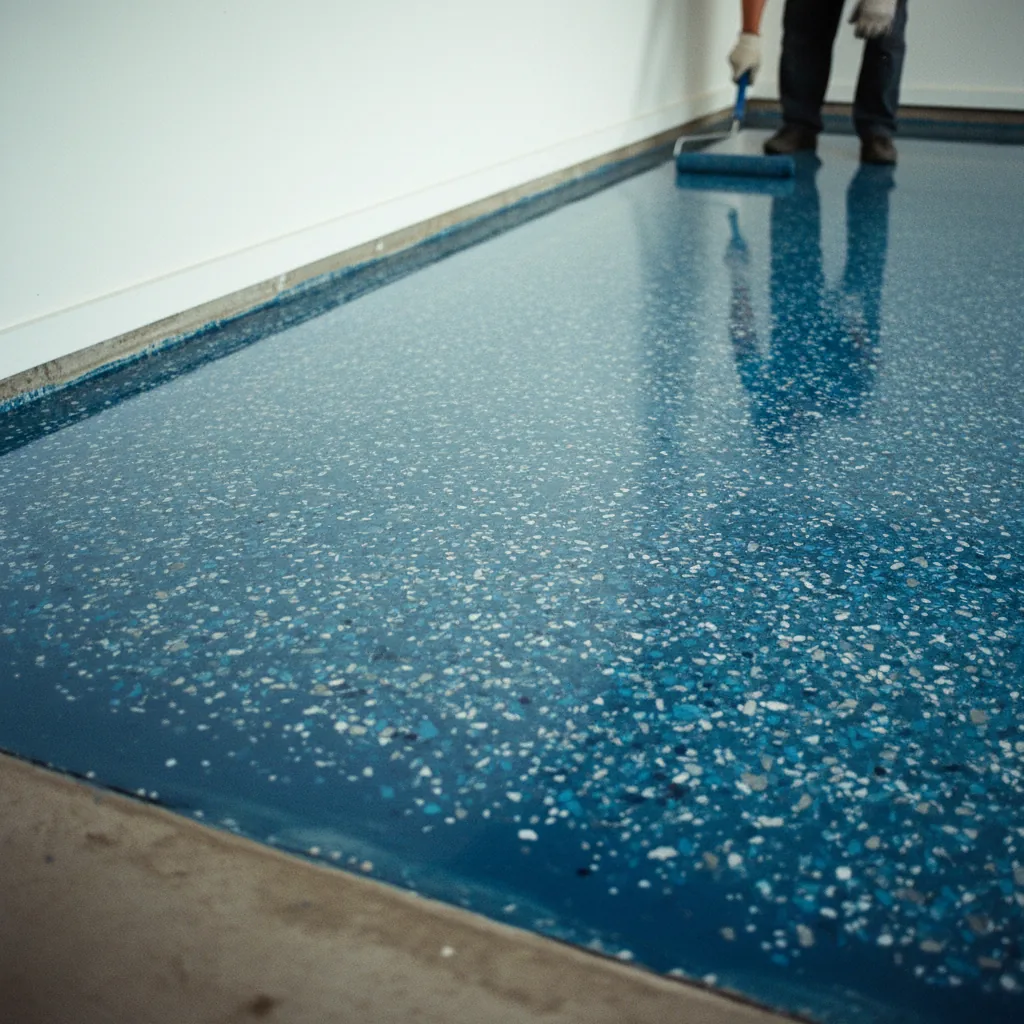
A garage floor in Dane County spends the winter under salt slush and melting snow, and the summer under hot tires. The coating has to handle both, and it only does that on a slab that was ground and repaired first.
Quick answer: A coated garage floor usually runs $4 to $8 per square foot, and a two-car garage usually runs $2,000 to $4,500. The slab moves the price more than the finish does. A cracked, oily, or damp floor needs more prep than a clean newer one. These are reference ranges only, and your floor gets its own number after it is measured and checked.
Bare concrete wears in a few ways you can spot on your own. Each one changes what the prep has to fix.
Unsealed concrete sheds a fine powder as the top wears down. It tracks into the house on shoes and settles on anything stored on the floor. A coating locks that surface in place. The worn layer still has to be ground off first, because a coating stuck to loose dust comes up with the dust.
Cars drip salt brine as the snow on them melts. The brine soaks into the top of the slab, freezes, and pops off thin flakes. Concrete people call this scaling. Deeper holes are spalls. Both get patched and ground flat before any coating goes down, and our concrete crack and spall repair page walks through that work. Why the damage shows up first by the door is covered in the post on freeze-thaw and epoxy in Madison.
Motor oil and transmission fluid soak deep into bare concrete. Grinding removes the top of the stain, and a degreaser pulls out more. A heavy, old stain can keep wicking oil up from below, which is one reason coatings fail in one spot and hold everywhere else. Tell us where cars have leaked.
If a store-bought coating is lifting in the tire paths, you already know the most common way these floors fail. The post on what to do when a DIY epoxy kit fails explains why it happens. The fix starts with grinding all of the old coating off.
Coatings bond by gripping the surface of the concrete. A smooth, sealed, or dusty surface gives them nothing to hold. There are two ways to open it up. Acid etching washes the slab with a mild acid. It is cheap and it is what most kits use, but it leaves an uneven surface and does little to old sealers or oil. Diamond grinding uses a heavy machine with diamond tooling to cut away the top skin. It leaves an even texture across the whole floor and removes old coatings in the same pass. You can compare the two in grinding vs acid etching.
Grinders should run with a HEPA-filtered dust vacuum attached. Concrete dust contains silica, which is harmful to breathe, so dry sweeping the dust is a bad idea. The edges along walls get done with a smaller hand grinder so the whole floor has the same profile.
Moisture gets checked before any coating is mixed. Water vapor moving up through the slab can push a coating off from below. The moisture testing guide shows the simple plastic sheet test you can try yourself.
Tires get hot on the drive home. When you park, the warm rubber softens a thin coating and sticks to it. As the tire cools and shrinks, it pulls on the coating. If the bond to the concrete is weak, a patch the size of your tread comes up with the tire. Kit coatings are thin and often go down over etched concrete, so they are the ones this happens to most. A thicker coating on a ground slab resists it much better. The details are in the post on hot-tire pickup, and the trade-offs of doing it yourself are in DIY epoxy vs professional.
| Option | Prep | Hot tires | Sun at the door | Back in use |
|---|---|---|---|---|
| Store kit (one-part or water-based) | Acid etch, done by the owner | Often lifts in the tire paths | Can fade or yellow | Per the label, often a few days |
| Epoxy base with polyaspartic topcoat | Diamond grind, crack repair | Resists well on a ground slab | Topcoat holds its color | Usually a few days to park |
| Full polyaspartic system | Diamond grind, crack repair | Resists well on a ground slab | Holds its color | Often sooner than epoxy |
If the garage door faces the afternoon sun, the topcoat matters more. Plain epoxy can turn amber over time in sunlight, as the post on epoxy yellowing shows. Our polyaspartic coating page goes deeper on that choice.
If you want a look beyond flake, like a solid color or a marbled finish, see the decorative flake and metallic coating page.
Many coatings give off a strong smell while they cure, and some are solvent-based and flammable. The garage is off limits to kids and pets until the floor has cured. Close the door into the house and keep the garage door partly open or run fans to push air outside. If a gas water heater, furnace, or other heater sits in the garage, it cannot run near a solvent-based product. Follow the product sheet on shutting off pilot lights. Relighting them is a job for a qualified person. Park somewhere else until the cure time on the sheet has passed. The post on epoxy cure time explains why cold weather stretches that wait.
A coating keeps salt out of the concrete, but the salt still arrives on your car. Squeegee meltwater toward the door or drain when puddles form. Every few weeks in winter, mop the floor with water and a mild, pH-neutral cleaner to lift the dried salt film. Skip strong acid cleaners. Put a piece of plywood under jack stands and a small plate under a motorcycle kickstand so a point load does not dent the finish. If the floor gets slick with slush, this post on wet epoxy floors covers mats and grit.
Call or text a few photos of the whole floor, the worst cracks, and any stains. Note the size of the garage if you know it. The estimate is free, and it is based on how much prep your slab needs. To see how costs add up first, read about garage floor epoxy cost or check the cost page. We coat floors in Madison, Sun Prairie, Fitchburg, Middleton, Verona and Waunakee.
Not as it is. A new coating can only hold as well as the layer under it, and a kit that is already lifting will keep lifting under the new one. The old coating gets ground off along with the top skin of the concrete, and then the slab is treated like bare concrete.
It depends on the product and the temperature. Most systems allow light foot traffic well before they allow a car. Follow the cure times on the product sheet for the system you choose, and give it extra time when the garage is cold. Parking early on a soft coating is one of the ways hot-tire marks start.
A smooth, glossy coating can be slick with melting snow on it. A full flake broadcast adds texture, and a fine grit can be mixed into the topcoat for more grip. You can ask for more grit near the door and the steps into the house, where water collects most.
The straight cuts in the slab are there to guide cracking. Some owners have them filled and coated over so the floor looks smooth. Others keep them open so any movement stays in the joint. Both are common, and the choice is worth making before the install starts.
The short concrete curb along the garage walls can be coated with the floor, which keeps salt water from staining it. The apron outside the door gets sun, plows, and standing slush, so it is a separate call. Ask about it when the floor gets measured.