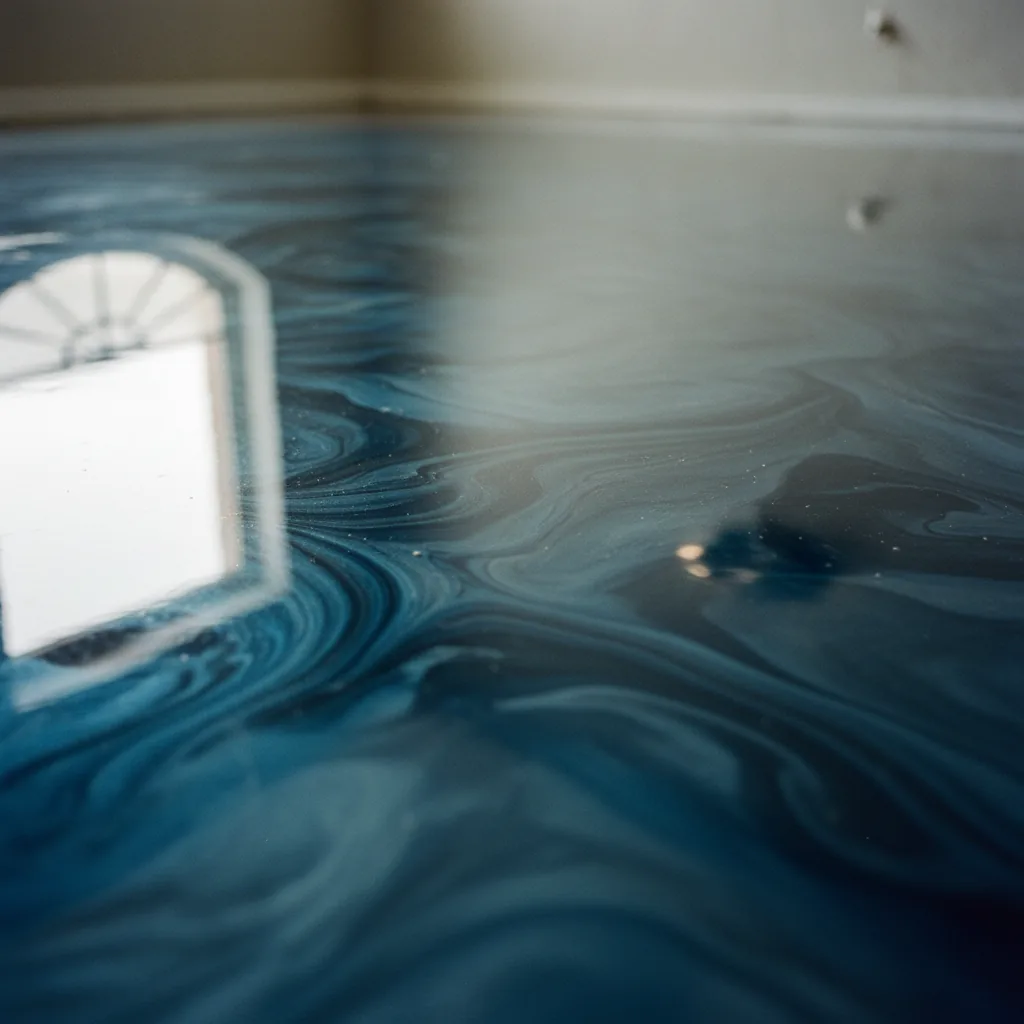
Flake gives a speckled floor that hides dirt and adds grip. Metallic gives a glossy, marbled floor. They suit different rooms, and this page helps you pick.
Quick answer: A flake floor is priced like a standard garage coating, which usually runs $4 to $8 per square foot. A decorative metallic floor usually runs $6 to $12 per square foot, since it takes more material, more coats, and more hand work. Slab condition and prep still move the final price.
| Finish | Look | Grip | Hides dust and flaws | Good rooms |
|---|---|---|---|---|
| Full flake | Speckled, like stone | Some texture from the flake | Very well | Garages, basements, shops |
| Partial flake | Scattered flake on a solid color | Smoother | Somewhat | Utility rooms, lower budgets |
| Metallic | Marbled, glossy, with depth | Slick unless grit is added | Poorly, shows dust and scratches | Basements, home bars, offices, showrooms |
| Solid color | Plain and bright | Depends on grit | Shows tire marks and dust | Workshops, commercial spaces |
If you are still deciding between looks, the post on flake vs metallic vs solid puts them side by side.
A flake floor starts with a base coat in a color close to the flake blend. While it is still wet, we throw handfuls of colored vinyl flake across it. In a full broadcast, the flake goes down until the base coat is fully covered and cannot hold any more. In a partial broadcast, the flake is scattered lightly so the base color shows through. Once the base cures, loose flake gets scraped off and vacuumed up. A clear topcoat then seals the flakes in.
The topcoat sets the feel of the floor. A thin topcoat over full flake leaves a light sandpaper texture that helps with grip. A thicker topcoat, or a second one, makes it smoother and easier to mop. Flake size matters too. Larger chips give a bolder look, and smaller chips read closer to a solid granite pattern. The post on one coat vs a full flake system explains why the full build lasts longer in a garage. For the garage version of this finish, see garage floor coating.
A metallic floor uses a clear or tinted epoxy mixed with fine pearl or metallic pigment. We pour it out and move it around with rollers, trowels, and brushes. The pigment settles into swirls, clouds, and veins as it flows. A light mist of solvent on the surface can push the pigment into cells and ripples. No two floors come out the same, and no one can promise an exact pattern ahead of time.
Metallic epoxy shows everything under it. High spots, low spots, and old patches can show through as flat or dark areas, so the slab has to be ground flat and repaired with care. It is also soft enough to scratch, so a harder clear coat goes on top. If the room gets sunlight, that clear coat should be one that holds its color, like a polyaspartic topcoat. Epoxy on its own can yellow in sun, as this post on yellowing shows.
Pick colors for the mess the room gets. Dark floors show dust, salt film, and lint. Very light floors show tire marks and dirt. Mid-tone flake blends with a few colors mixed in hide both. Lighting changes how a color looks. A blend that looks warm in daylight can look gray under cool LED shop lights. Look at a real sample board on your own floor, with your own lights on, at the time of day you use the room most.
Glossy finishes can be slick when wet, and metallic floors are the smoothest of all. A fine grit, usually a clear aluminum oxide, can be mixed into the last coat. It adds grip with little change to the look. It is worth adding by sinks, stairs, and doors. The post on slippery epoxy floors covers how much grit to use where.
Some metallic techniques use a flammable solvent spray, and many clear coats are solvent-based too. Anything with a flame has to be off or far away while the product goes down and cures, and that includes pilot lights and any heater. The product sheet says for how long. A qualified person should relight the pilot lights after. Fans pushing air outside help clear the smell, and the room stays closed to children and pets until the floor is ready.
Send photos of the room and tell us the look you want. A picture of a floor you like helps a lot. The estimate is free. If metallic is headed for a basement, read the basement floor coating page first, since moisture matters even more under a clear finish. We coat floors in Madison, Sun Prairie, Fitchburg, Middleton, Verona and Waunakee.
It can, but it is a harder fit. Metallic floors are smooth, so they get slick when snow melts off a car. Grit trapped under tires can leave fine scratches that show on the glossy surface. A flake finish is more forgiving in a garage. If you want metallic there anyway, add grit to the topcoat and plan on a UV-stable clear coat if the door faces the sun.
Flake comes in many premade blends, and custom mixes are possible. Look at a real sample under your own lights before you decide, since a small photo on a screen rarely matches how the floor looks in person.
Not when the system is built right. The flakes land in a wet base coat and stick there. The loose flakes on top get scraped and vacuumed off, and then a clear topcoat seals everything in. Flakes that come loose are a sign the topcoat was too thin or skipped.
Small scratches can often be buffed and recoated. A deep gouge is harder. Every metallic pour is one of a kind, so a patch rarely matches the swirls around it. Recoating the whole room, or a section that ends at a natural line like a doorway, looks better.
Flake systems follow the same schedule as a standard coating. Metallic floors often take longer, because they may need a primer, a metallic coat, and one or more clear coats, and each has to cure. The product sheet for each layer sets the waits.