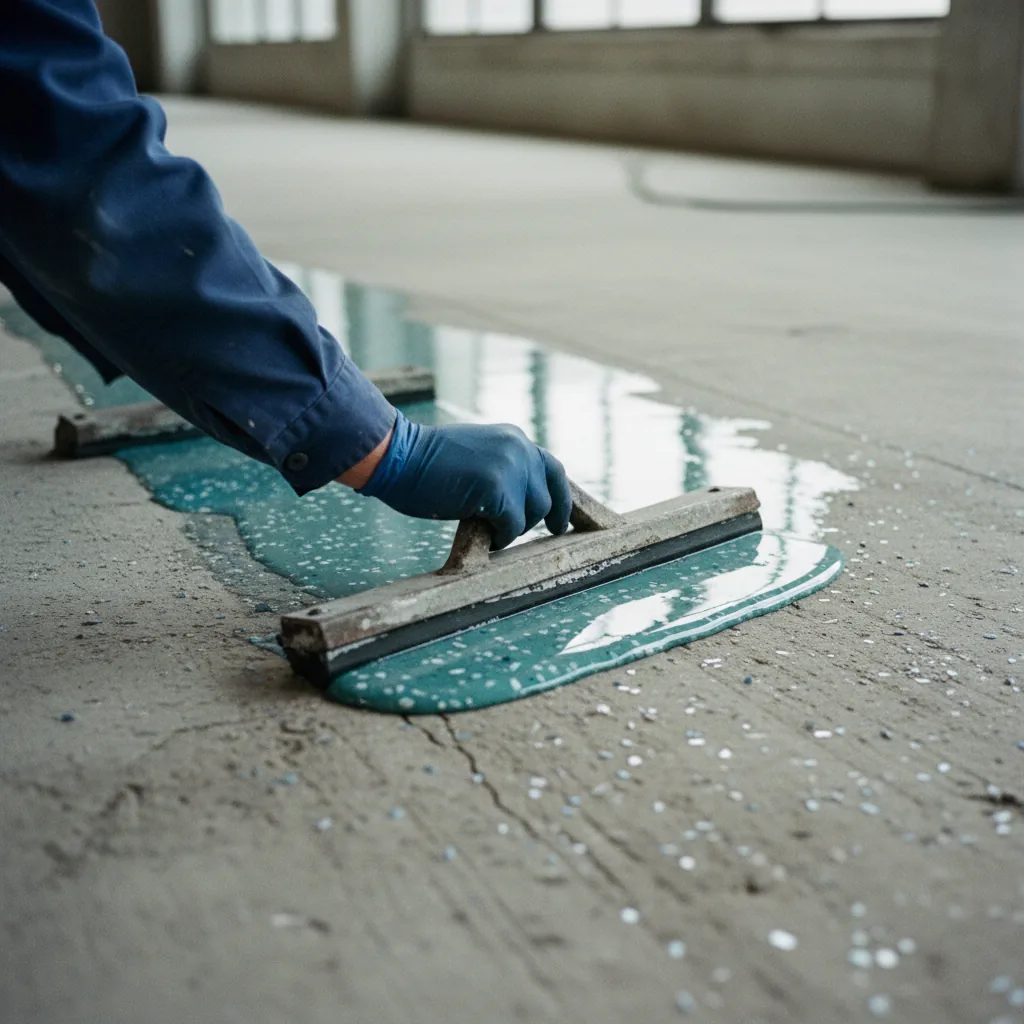
Polyaspartic cures fast and keeps its color when sunlight hits it. It also sets fast, so there is very little time to spread it, which is why the choice between it and epoxy comes down to your floor and your schedule.
Quick answer: A polyaspartic floor coating usually runs $6 to $10 per square foot. It costs more than a plain epoxy system because the material costs more and it has to be put down quickly. The main reasons to pay for it are faster return to use and a finish that does not yellow in sunlight. Slab condition and prep set the final price.
Most floor epoxies are made from resins that slowly turn amber under ultraviolet light. Indoors in a dark basement, that barely matters. In a garage where the door is open on summer afternoons, you can end up with a yellow band across the front of the floor. Polyaspartic is built from a different type of resin that holds its color much better in UV light. The post on why epoxy floors yellow shows what that change looks like.
Epoxy coats often need most of a day before the next coat can go on, so a full system can take several days. Polyaspartic coats can often be recoated within hours. That is how a full system can go down in one day. You still wait before walking on it and wait longer before driving on it. The times come from the product sheet, and epoxy cure time explains what slows curing down.
Epoxy slows way down in a cold garage. Many polyaspartics are made to cure at lower temperatures, which stretches the season for a coating in Wisconsin. The lower limit still exists, and the slab has to stay above the dew point so no moisture condenses on it. Each product has its own limits.
As a topcoat, polyaspartic stands up well to scuffing and to the chemicals a garage sees, like road salt, gas drips, and windshield fluid. That is why many systems put it on as the last layer even when epoxy goes underneath. The post on polyaspartic topcoats covers that setup.
Once polyaspartic is mixed, there is a short window to spread it before it starts to set. On a warm, humid day, that window gets even shorter. Material has to be mixed in small batches and rolled out with a steady rhythm, or you get lap marks and thick spots. Bubbles can also form if it goes down over a slab that is warming up and pushing air out, which the post on epoxy floor bubbles explains. This is a big part of why polyaspartic is rarely sold as a weekend kit.
Each coat also goes on fairly thin. Epoxy can be laid down thicker, which helps fill small dips and hide a rough slab. Some polyaspartics bond well to bare ground concrete, and some call for an epoxy primer first.
| Question | Epoxy | Polyaspartic |
|---|---|---|
| Time between coats | Often most of a day | Often a few hours |
| Time to work after mixing | Longer, easier to spread | Short, needs an experienced installer |
| Sunlight | Can turn amber over time | Holds its color |
| Cold garage | Slows down a lot | Many products cure in cooler conditions |
| Thickness per coat | Can go on thick and fill low spots | Thinner coats |
| Reference price | $4 to $8 per sq ft for a garage system | $6 to $10 per sq ft |
For a longer look, read epoxy vs polyaspartic, and for local price math, the Madison cost comparison.
A full polyaspartic floor uses it for the base coat and the topcoat. It is the fastest route back into the garage. A hybrid uses an epoxy base, often with a flake broadcast, and a polyaspartic clear coat on top. You get the thicker epoxy layer underneath and the UV-stable wear layer on top, at a price between the two. Polyaspartic also works as a clear coat over a marbled metallic floor that gets some daylight. If you are weighing how many layers you need, one coat vs a full flake system lays out the difference. For the garage version of this job, see the main garage floor coating page.
Many polyaspartic products contain solvent and have a sharp smell while they cure. That smell can move into the house through an attached garage. Close and seal the door into the house, move air out through the garage door or with fans, and give it time to clear. Children and pets should stay out until the product sheet says the floor has cured. A lit cigarette, an open flame, or a running pilot light near a solvent-based coating is a fire risk while it cures. We plan around gas appliances before install day.
Call or text photos of the floor and tell us which way the garage door faces, since sun exposure is one of the main reasons to pick polyaspartic. The estimate is free. The cost page shows every price range on the site. We coat floors in Madison, Sun Prairie, Fitchburg, Middleton, Verona and Waunakee.
Polyaspartic is one kind of polyurea. Plain polyurea sets so fast it is usually sprayed with special equipment. Polyaspartic is a version made to set slower, so it can be rolled onto a floor by hand. Product names blur the two, so ask which chemistry a quote is for.
If the epoxy is still tight to the concrete, it can be sanded to dull the gloss, cleaned, and topcoated. If it is peeling, bubbling, or lifting in the tire paths, it has to be ground off first. A new topcoat does not fix a failing bond underneath.
A full polyaspartic system can often be installed in one day, because each coat is ready for the next one within hours. Ready to install and ready to park are different things. The product sheet gives separate times for foot traffic and for vehicles, and cold or dry air can stretch both.
Many polyaspartics are made to cure at lower temperatures than epoxy, which helps in a Wisconsin fall. There is still a lower limit for the slab and the air, and the slab has to stay a few degrees above the dew point so moisture does not form on it. Each product has its own limits.
A clear polyaspartic topcoat over a smooth surface is glossy and can be slick when wet. Over a full flake broadcast, it keeps some texture. Fine grit mixed into the final coat adds grip and is worth it by the door where snow melts off cars.