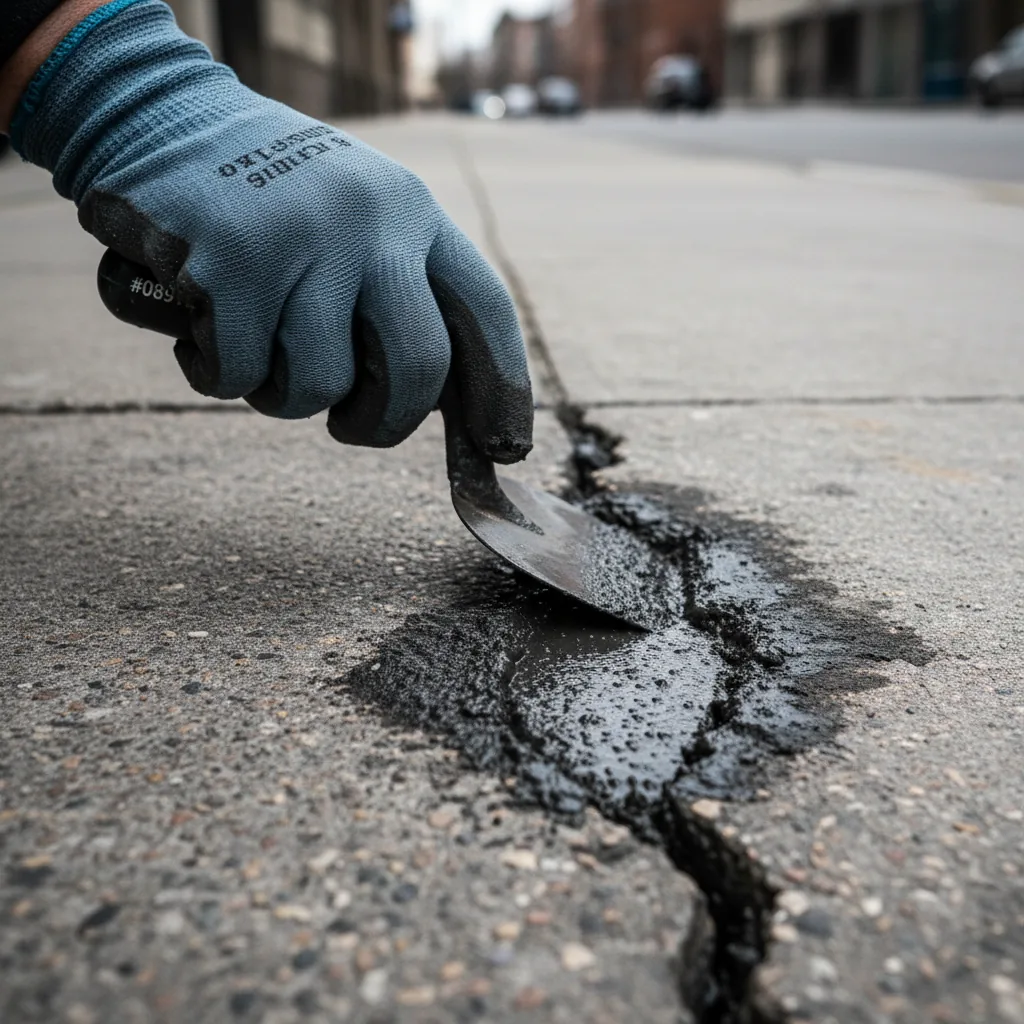
Cracks, pits, and salt-flaked patches have to be fixed before a floor coating goes down, or they show right through it. Some slabs just need the repair.
Quick answer: A standalone slab repair usually runs $300 to $1,200, depending on how many cracks there are, how wide they are, and how much surface damage needs patching. When the floor is also getting coated, the repair is part of the prep and is priced into the coating job.
Walk the floor with a flashlight held low to the surface. The low light makes cracks, lips, and shallow pits much easier to see. Then compare what you find to the types below.
Almost every slab has these. Concrete shrinks as it dries after the pour, and it cracks to relieve the stress. If the two sides sit level with each other and the crack is not getting wider, it is likely a shrinkage crack. These are the simplest to repair. The crack gets opened with a grinder, cleaned out, and filled.
Put a pencil mark at each end of a crack and check it again in a few months. If it grows, the slab is still moving. Soil under the slab can settle, or water can freeze under it near the door. A moving crack is usually filled with a more flexible material so it can move a little without tearing. It may still show a faint line through a coating later.
When one side of a crack sits higher, the slab has heaved or settled. A small lip can be ground flat so nobody trips on it and the coating lies smooth. A big drop, or a section that sounds hollow when you tap it, points to a gap or washout under the slab. Lifting a sunken section is done by a concrete leveling contractor, and it comes before any coating.
Salt brine from cars soaks into the top of the slab, freezes, and pops off the surface. Light flaking is called scaling. Deeper holes are spalls. The loose concrete gets ground or chipped out down to solid material. The hole is then filled with a repair mortar or an epoxy patch and ground level with the rest of the floor. The post on freeze-thaw and epoxy explains why this damage gathers where cars park.
Popouts happen when porous bits of stone near the surface soak up water, freeze, and break loose. Shallow pits can also form when the top of the slab was finished too wet. They get filled during prep. A flake finish hides the small ones well.
| Damage | Likely cause | Common fix | Under a coating |
|---|---|---|---|
| Thin, level crack | Shrinkage after the pour | Chase and fill with a rigid filler | Usually disappears |
| Crack that keeps growing | Soil or frost moving the slab | Flexible filler | A faint line may return |
| Lip at a crack | Heave or settling | Grind flat, or level the slab first | Smooth once flat |
| Scaling and spalls | Salt and freeze-thaw | Remove loose concrete, patch, grind | Hidden when patched level |
| Control joint | Cut on purpose when poured | Fill, or keep it open | Your choice |
The first step is to open the crack. A grinder with a narrow blade cuts along it and turns a hairline into a small V. This cleans out dirt, oil, and old sealer and gives the filler two clean faces to grip. A vacuum pulls out the dust. The filler goes in a little proud of the surface. Once it sets, the whole floor gets diamond ground, and that pass takes the filler down flush with the slab. The coating then goes over one even surface. The post on cracks in a garage floor before epoxy goes through each stage, and epoxy floor prep cost shows how repair time adds to a quote.
The filler has to suit the coating that goes on top. Most coating systems name the crack fillers and patch products that work with them. Using a random tube of hardware store caulk can leave a soft spot the coating does not bond to.
Some problems a floor repair cannot solve. If water seeps up through a basement crack after rain, the fix is drainage or waterproofing. The basement floor coating page covers how moisture is checked. If a crack runs from the floor up into a foundation wall, or the wall is bowing, have a foundation contractor or a structural engineer look at it. If large sections have sunk, a leveling contractor lifts them first. Filling the crack in any of these cases hides the symptom for a while.
Most repairs happen as the first stage of a garage floor coating. Commercial floors with chipped joint edges are covered on the commercial floor coating page.
Cutting and grinding concrete makes dust that contains silica, which damages the lungs when breathed in. The tools should run with a HEPA-filtered dust vacuum attached. Children and pets should stay out of the room while the grinder runs. If you try a small repair yourself, wear a proper respirator and eye protection, and do not dry sweep the dust.
Text photos of the worst cracks with a coin or a tape measure next to them so the width shows. Tell us if any crack has grown or if water comes through it. The estimate is free. The cost page lists every range. We coat floors in Madison, Sun Prairie, Fitchburg, Middleton, Verona and Waunakee.
A dry shrinkage crack that has stopped moving usually stays closed once it is filled. A crack that is still moving, because the soil under the slab shifts or the ground freezes and thaws, can open again. A faint line may show through the coating over it. That is why moving cracks are often filled with a softer, flexible filler.
Yes. Standalone repair is its own job. On bare concrete, the filled crack will show as a line in a different color from the slab around it. If you plan to coat later, tell us, so the filler works under a coating.
A hairline crack is too narrow for filler to get into. Cutting it open into a small V with a grinder cleans out the dirt and old sealer and gives the filler room to grip both sides. This step is called chasing the crack.
Control joints are the straight cuts made on purpose so the slab cracks along them. Filling them gives a smooth floor, and a coating can go right over. Leaving them open, or cutting them back in after the coating, lets any movement stay in the joint. Either is a normal choice.
Many crack fillers and patch materials are made to be ground and coated within hours. Some cement-based patches need longer. The product sheet for the repair material sets the wait.